SPRING 2012 | ELIZABETHTOWN COLLEGE
College’s Food Waste Generates Electricity for Local Farm and 200 Homes
Sustainability isn’t new to Elizabethtown College, a small, private institution with 2,000 students in south central Pennsylvania. The college made a long-term commitment to social responsibility and reducing its impact on the environment. It takes a proactive approach to the efficient use of water, natural gas, fuel oil and electricity, as well as the reduction of waste water and solid waste.
// Read more
SPRING 2012 | EVOLVING DOOR
Four Emerging Trends
Over the past several years, there has been a greater focus on foodservice sustainability. While local sourcing of products is one of the most tangible elements of a sustainable program, many consultants and foodservice professionals found local sourcing logistically difficult and expensive. They also discovered that certain foods were available only during specific times of the year, which limited product choices.
// Read more
SPRING 2010 | WHAT'S NEXT
What’s Next for Foodservice Waste Management
In a recent Foodservice Equipment & Supplies article, Andrew Shakman, president
and CEO of LeanPath, a technology company that provides food waste tracking systems,
offered several concepts foodservice operations should master if they want to make
waste management a real priority.
// Read more
WINTER 2009 | TESTING
Testing One, Two, Three
Testing plays an important role in product development. It’s the only way to make
sure a product performs like the designers intended. Hobart opened its 113,000-square-foot
Technology Center in 1990 and has been torturing its equipment ever since.
// Read
more
SUMMER 2009 | WASTE MANAGEMENT EVOLVES
Evolving Door: Trends Emerge as Food-Waste-Management
Practices Evolve
Over the past several years, there has been a greater focus on foodservice sustainability.
Many foodservice operations and consultants are interested in waste management because
it is simple to implement and makes an economic difference, rather than requiring
greater economic resources.
// Read more
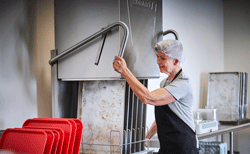
SPRING 2009 | Self-Busing Offers Additional Waste-Management Strategy
When feeding large groups of people in a cafeteria, unloading and cleaning dishes
and trays can require a significant amount of time and money. Additionally, if each
dish and each tray has to be individually scraped and loaded, a great deal of manpower
is utilized to clean the dishes. A simple solution to reducing the amount of time
involved in cleaning the dishes is to implement a self-busing system.
// Read more
WINTER 2008 | WASTE HANDLING
Waste Handling That’s Economical and Environmentally
Friendly
In today’s environment, properly disposing of waste requires more than just bagging
up trash. Common waste-disposal solutions include recycling, composting and pulpers,
all of which are resolutions to reducing waste.
// Read more
FALL 2008 | HOLISTIC APPROACH
To Be Successful, Take a Holistic Approach to Waste Management
There can be several different components to a waste-management program, but Andre
LaRiviere, executive director of the Green Table Network, emphasizes foodservice
operations must take a holistic approach to be successful.
// Read more
SUMMER 2008 | WASTE NOT, WANT NOT
Waste Not, Want Not
Eliminating waste might not be a reality for many foodservice operations, but there
are several ways they can significantly reduce solid waste and waste costs.
// Read more